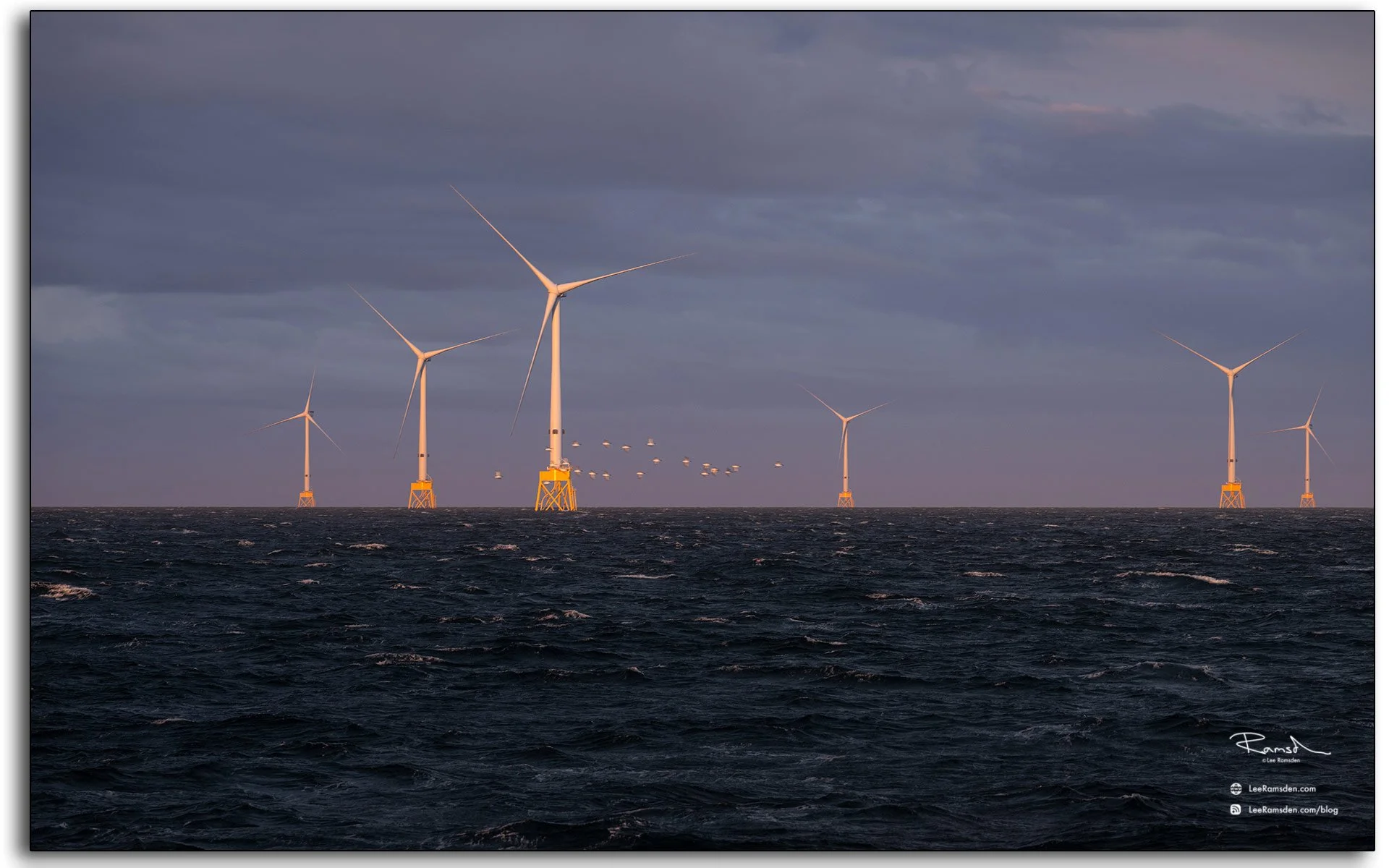
There is a version of this photograph without the birds. It would be a competent dusk shot: five turbines evenly spaced across the horizon, their yellow jacket foundations catching the last of the warm light against a cooling blue-grey sky, a textured sea in the foreground. Worth keeping, not worth writing about.
The birds change that entirely.
The flock appeared between the central turbine and its neighbour to the right at the moment the frame was taken. They are too distant and too small to identify with certainty, but the wing shape and the loose, disorganised formation suggest gannets or large gulls rather than a tightly structured species like starlings or waders. They are not reacting to the turbines. They are passing through the same airspace and happened to be there.
That is the thing about unplanned elements in a photograph: they either ruin the frame or they complete it. A bird out of position, or a flock at the wrong height, would have broken the spacing between the turbines and created visual noise. This flock sits at exactly the right height, between exactly the right two structures, in a loose enough formation to read as a single element without obscuring anything behind it. There was no way to anticipate it. The frame either happened or it did not.
The light in this image deserves its own note. The sky is cool and flat, the cloud cover diffusing whatever remained of the sun at this hour into a uniform blue-grey. The turbine towers and blades are picking up that same cool tone and reading as white-grey against the sky. The jacket foundations, however, are a different story. The yellow paint on the lower sections of the structures is catching a band of warm light that did not reach the upper parts of the turbines, the result of the sun being below the cloud base at the horizon but still illuminating the sea-level structures from a low angle. The contrast between the warm foundations and the cool towers is subtle but present, and it is what stops the image reading as flat.
Five turbines in a row at this distance is a composition that could feel repetitive. The even spacing, the identical structure type, the symmetrical arrangement: these are the characteristics of an engineered array rather than a natural landscape. What prevents that reading here is the variation introduced by the light on the foundations and the irregular, animate presence of the bird flock. Neither was placed. Both were noticed.
Offshore wildlife turns up in the most engineered environments. The earlier post in this series on seabirds at the wind farm covered individual birds in flight. This frame is about the relationship between a moving group and a fixed structure, and what that looks like when the timing works out.
More work from the wind industry is in the Wind Industry portfolio.

