Wind Turbine

Black and White Turbines at Sea

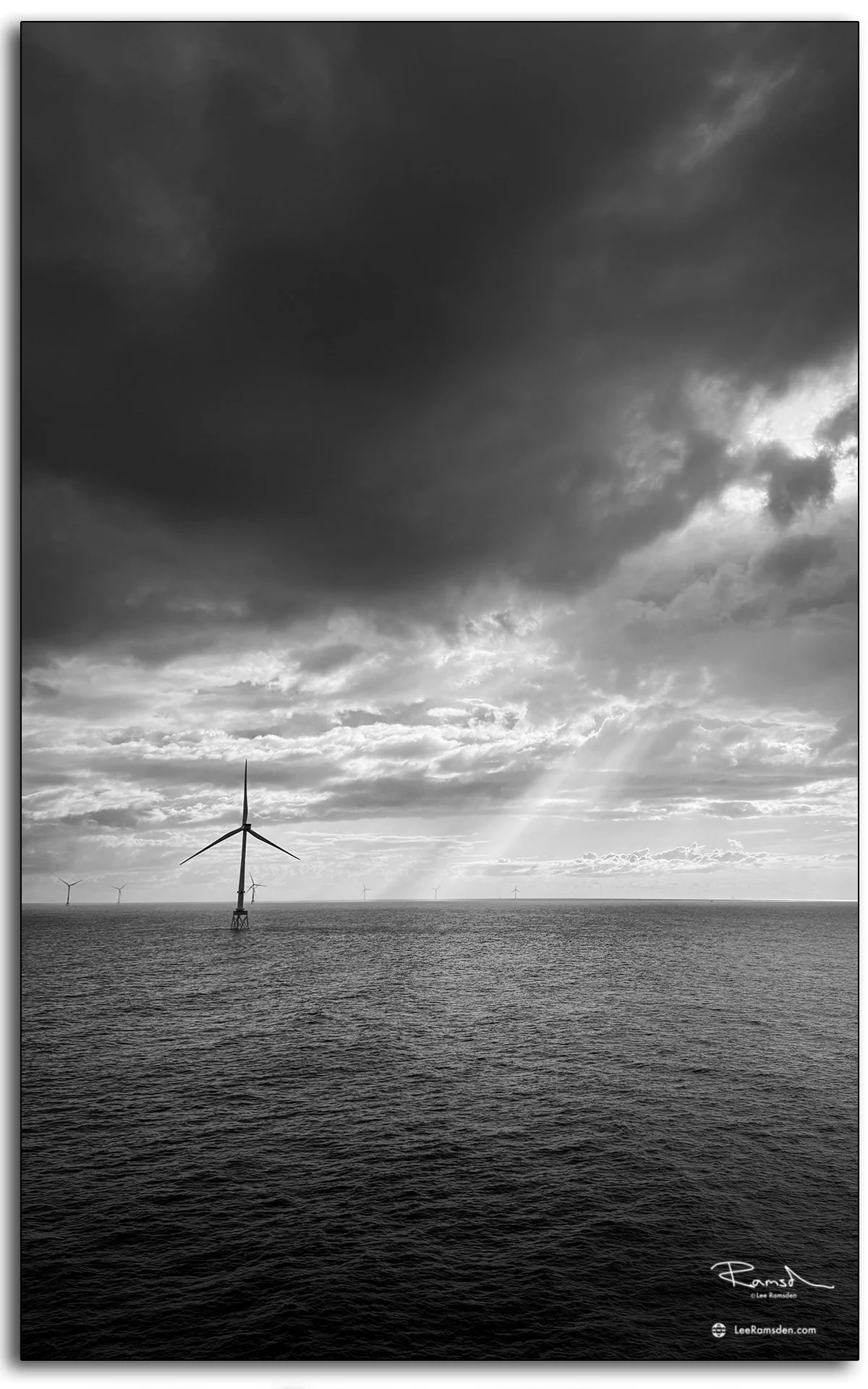
Offshore wind turbine beneath dark skies with light rays breaking through the clouds, captured in monochrome.
Monochrome offshore wind turbine set against moody skies and the North Sea horizon.

The offshore wind farm takes on a different presence in black and white. Without colour, the turbines stand stark against the shifting tones of sea and sky. The heavy clouds and breaking light add a drama that colour often softens, leaving a raw sense of scale and isolation.

These iPhone images strip everything back, reducing the view to light, shadow, and structure — highlighting the resilience of the turbines set against the vastness of the North Sea.

These black and white studies show another side to offshore wind — stripped of colour but rich in atmosphere. See more from my Wind Industry portfolio.

How Tall Are Offshore Wind Turbines? — Technical Info & UK Offshore Examples

UK offshore wind turbine up close; tower height, blade rotation, scale against sea.

Offshore wind turbines are massive — but how massive? On UK wind farms, turbines can reach up to 204 m to the blade tip, with blade diameters around 164 m. These numbers aren’t just statistics — they shape visual scale, installation requirements, and how turbines integrate into sea and sky.

The turbine in the video above comes from a UK offshore wind farm. At full height of 204 m, the blade tip sweeps an arc almost twice that of many older onshore turbines. For comparison, many onshore turbines are 80-120 m in tip height. That scale affects logistics — transport, foundation design, sea access — and affects what the turbine looks like from shore or sea.

Seeing one in place, through video, gives a real impression of height and movement. The blade diameter of 164 m means each blade is longer than many football fields are wide, and the swept area covers hectares. Height also changes how shadows, wind, and light interact with the structure — tall towers catch more wind, reflect more sky, and tower over waves.

Technical specs like this help understanding what wind turbines are and what they do. For more photographs of UK wind farms, structure and scale, see my Wind Industry and Places galleries.

What does your commute to work look like?

Good morning,

Today id like to share a short video of how we access an offshore substation on a windfarm.

After a 1.5hrs CTV (crew transfer vessel) ride, it is a large ladder climb on to the platform.

Where as this may not be for everyone, I will take this, over being stuck in traffic on the M25 every single time!

Fog creeping in.

Hello, here are some images of the fog slowly creeping in, over the windfarm.

The fog approaches like a soft whisper, gradually swallowing the horizon. The wind turbines, once clear and imposing, begin to fade into the mist, their outlines becoming ghostly silhouettes

The Edda Brint, SOV (service operations vessel) adjacent to our substation.

Housing 60 persons, the 60 PAX will be made up with the ships crew and technicians who are servicing the turbines.

The Wind Cat CTV (crew transfer vessel) This vessel is our daily transport to and from shore.

As the fog thickens, the turbines seem to float in mid-air, their blades slicing through the mist with a gentle, rhythmic motion. This ethereal scene creates a stark contrast between the solid structures and the ephemeral fog.

Have you captured the beauty of fog in your photography? Share your images and comments over on Instagram @lee_ramsden

Thanks

Lee

Substation in the sun.

Hello,

Today I’d like to share a couple of images of an OSP (offshore substation platform)

I always enjoy, how I can take many photos of the same subject, and with the differing skies and ever-changing weather can change the image.

Which one do you prefer?

Leave a comment over on instagram @lee_ramsden

Thanks

Lee