wind farm

Norwind Storm at Work

Norwind Storm offshore support vessel approaching a wind farm substation in the North Sea
Norwind Storm vessel at sunrise with wind turbines on the horizon, captured in the North Sea

Out in the North Sea, the Norwind Storm is a familiar sight—steady, purposeful, and always where the work is. These iPhone images capture the vessel alongside the offshore substation, with the wind turbines fading into the haze and the low sun throwing golden light across the water.

From the deck or framed against the open horizon, the Storm stands as a reminder of the constant effort behind the offshore wind industry. The scale of the operation is immense, yet moments like these bring out its quiet beauty.

See more of my work in the Wind Industry portfolio.

Offshore Walk-to-Work Transfers

Side view of offshore Walk-to-Work bridge extended to platform, photographed at sunrise.
Offshore crew gathered in PPE, preparing to transfer via Walk-to-Work bridge.

Crew transfers offshore are all about routine, discipline, and trust in the equipment. These images show the daily process of moving between vessel and platform via the Walk-to-Work bridge.

Offshore worker in survival suit crossing Walk-to-Work bridge in calm sea conditions.
Worker crossing Walk-to-Work bridge at sunrise, with offshore crew waiting behind.

The W2W system is straightforward in purpose: to give workers safe access. These photographs focus less on the structure and more on the people — the steady flow of personnel, kit bags in hand, crossing in both directions. It’s a reminder that offshore operations are built on repetition and reliability, not just engineering.

This series continues my documentation of offshore work and life at sea. For more, visit my Wind Industry and Industrial galleries.

Crew Transfer Vessels in Offshore Wind: Farra Grainne at Work

These images focus on the Farra Grainne, a crew transfer vessel working offshore within a wind farm environment. Taken in calm conditions and clear light, they show the vessel in a few different contexts: close alongside, moving away through the field, and positioned next to the structure during transfer operations.

In offshore wind, crew transfer vessels, usually shortened to CTVs, are a core part of daily operations. Their job is to move technicians and small teams between shore or a mothership base and offshore assets such as turbines and substations. They are specifically designed for that role, and in many projects they remain the preferred transfer solution for sites closer to shore. 

The transfer itself is one of the most important parts of the process. Industry guidance from G+ and the Energy Institute is built around the principle that people should not fall into the sea or become trapped between the vessel and the offshore structure during transfer. That is why vessel design, operating procedures, competence and transfer arrangements matter so much. 

It is easy to look at a wind farm and focus only on the turbines, but the day-to-day operation relies on far more than that. CTVs are one of the clearest examples. They are there to move people, equipment and capability around the site, and without them a lot of offshore maintenance simply would not happen in the same way. General guidance on offshore wind service vessels also notes that CTVs are designed specifically to transport service teams and are commonly fitted for transfer work against offshore structures. 

How Tall Are Offshore Wind Turbines? — Technical Info & UK Offshore Examples

UK offshore wind turbine up close; tower height, blade rotation, scale against sea.

Offshore wind turbines are massive — but how massive? On UK wind farms, turbines can reach up to 204 m to the blade tip, with blade diameters around 164 m. These numbers aren’t just statistics — they shape visual scale, installation requirements, and how turbines integrate into sea and sky.

The turbine in the video above comes from a UK offshore wind farm. At full height of 204 m, the blade tip sweeps an arc almost twice that of many older onshore turbines. For comparison, many onshore turbines are 80-120 m in tip height. That scale affects logistics — transport, foundation design, sea access — and affects what the turbine looks like from shore or sea.

Seeing one in place, through video, gives a real impression of height and movement. The blade diameter of 164 m means each blade is longer than many football fields are wide, and the swept area covers hectares. Height also changes how shadows, wind, and light interact with the structure — tall towers catch more wind, reflect more sky, and tower over waves.

Technical specs like this help understanding what wind turbines are and what they do. For more photographs of UK wind farms, structure and scale, see my Wind Industry and Places galleries.

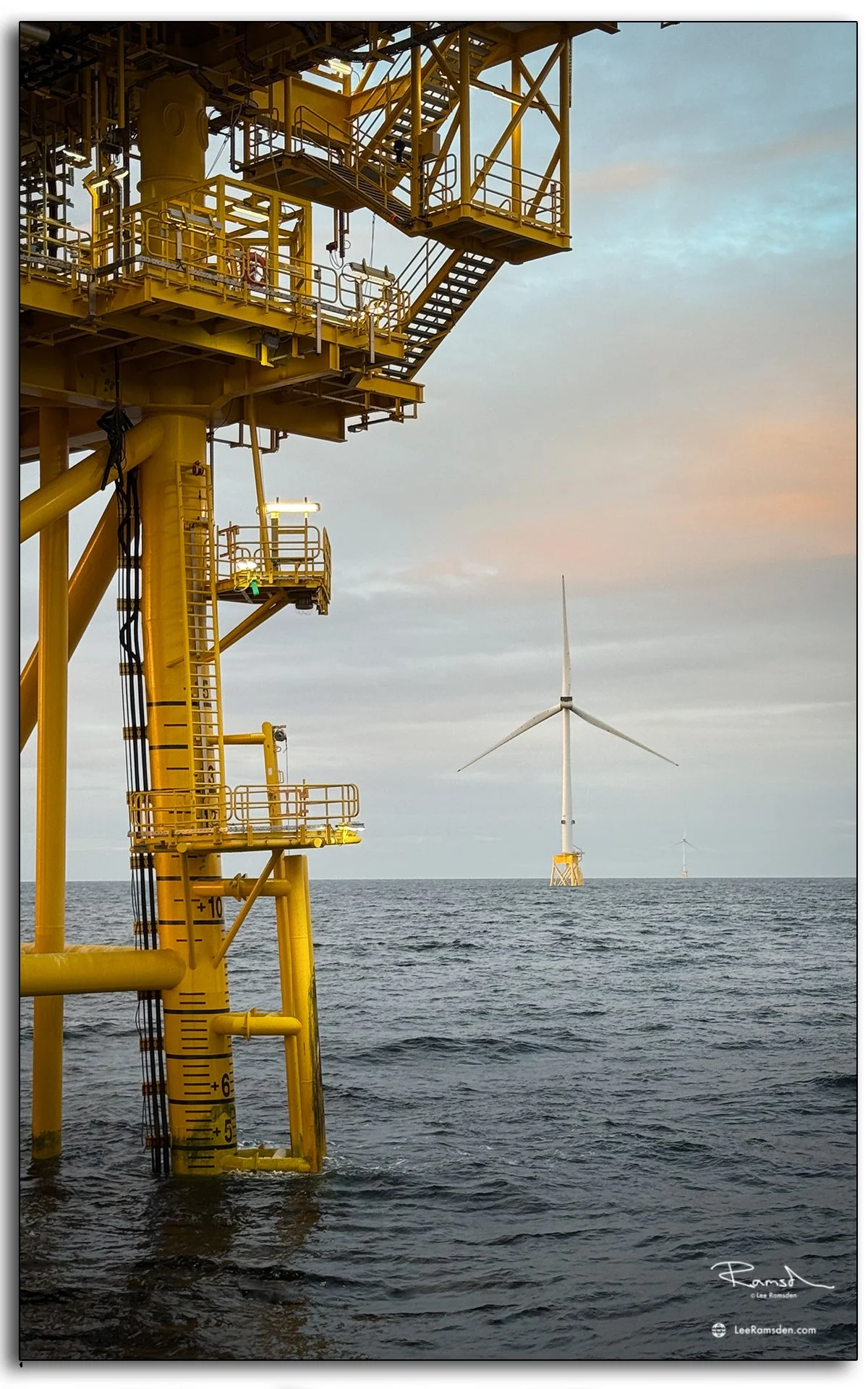
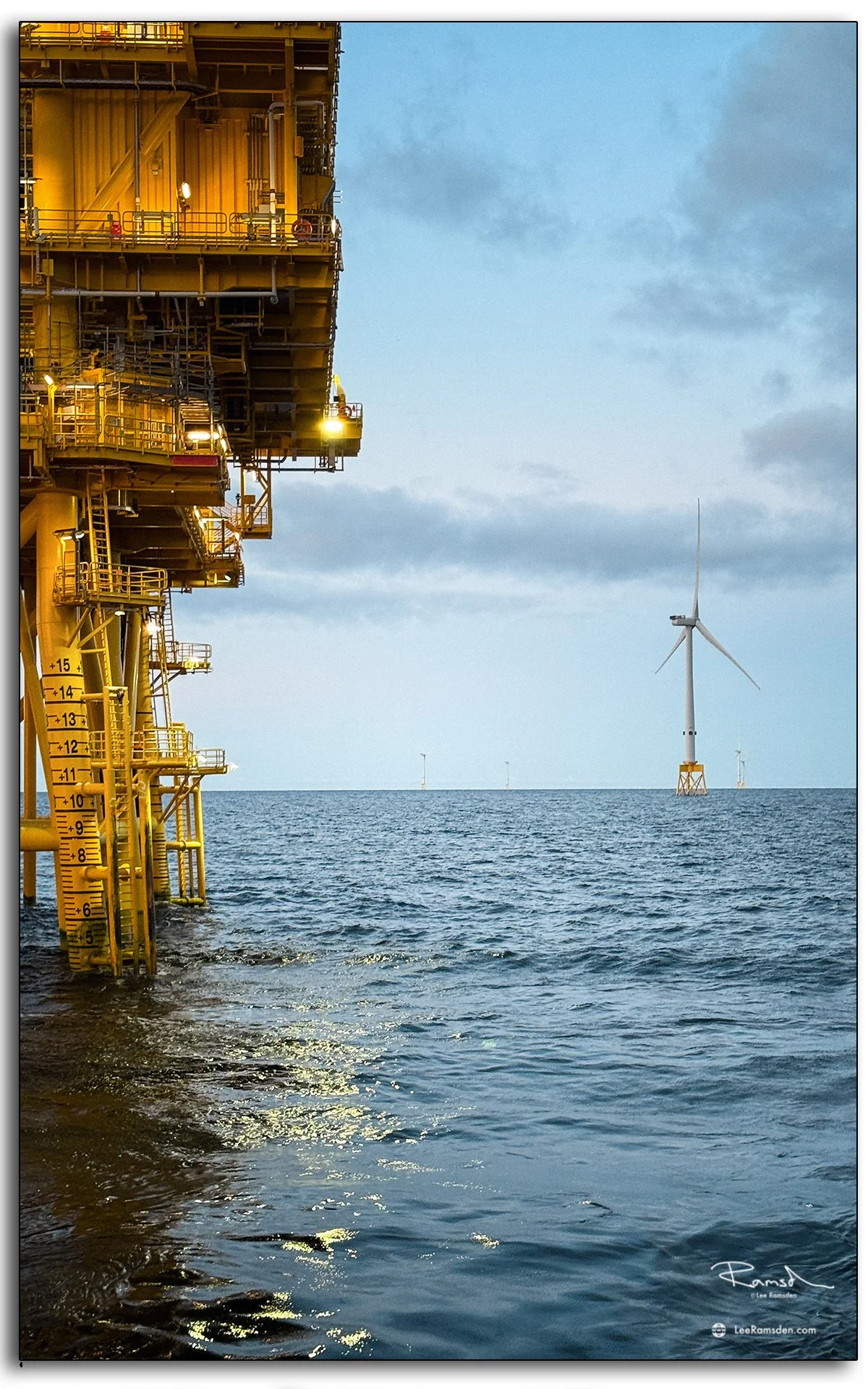
Wind farm substation

The Hollandse Kust Zuid offshore wind farm is one of the largest in the Netherlands, located in the southern North Sea off the Dutch coast. The offshore substation at its heart collects the electrical output from the surrounding turbine array and transmits it back to shore via subsea cable — a critical piece of infrastructure in any large-scale offshore wind project.

These photographs show the substation from several angles and distances — the platform structure, deck equipment, and its relationship to the turbines and sea around it. Low sun and clear conditions on this rotation made for good contrast across the steelwork and gave the images a cleaner quality than overcast offshore days typically allow.

The project is operated by Vattenfall and connected to the Dutch grid via TenneT, the Dutch and German transmission system operator. It is one of several major offshore wind farms that have shaped the southern North Sea energy landscape in recent years.

For more photography from offshore substations and wind farm operations, visit the Wind Industry gallery.

Fog creeping in.

Hello, here are some images of the fog slowly creeping in, over the windfarm.

The fog approaches like a soft whisper, gradually swallowing the horizon. The wind turbines, once clear and imposing, begin to fade into the mist, their outlines becoming ghostly silhouettes

The Edda Brint, SOV (service operations vessel) adjacent to our substation.

Housing 60 persons, the 60 PAX will be made up with the ships crew and technicians who are servicing the turbines.

The Wind Cat CTV (crew transfer vessel) This vessel is our daily transport to and from shore.

As the fog thickens, the turbines seem to float in mid-air, their blades slicing through the mist with a gentle, rhythmic motion. This ethereal scene creates a stark contrast between the solid structures and the ephemeral fog.

Have you captured the beauty of fog in your photography? Share your images and comments over on Instagram @lee_ramsden

Thanks

Lee

Substation in the sun.

Hello,

Today I’d like to share a couple of images of an OSP (offshore substation platform)

I always enjoy, how I can take many photos of the same subject, and with the differing skies and ever-changing weather can change the image.

Which one do you prefer?

Leave a comment over on instagram @lee_ramsden

Thanks

Lee

A ship with legs.

Good morning.

Images of the Wind Orca with a walk to work bridge.

The Wind Orca vessel provides a safe, efficient, and reliable solution for the installation, maintenance, and decommissioning of wind farm projects. Their advanced specifications set the industry benchmark for vessel transit speed, lifting capability, DP station keeping and jacking speed, offering a significantly improved operating weather window. They are fitted with high-quality equipment, supported by advanced preventative maintenance systems, and incorporate a significant level of operating redundancy. Safety is enhanced through a 6-leg design that allows them to operate even on sites with the most challenging seabed conditions.

Let me know what you think of these recent posts I love to hear from you on Instagram @lee_ramsden

Thanks

Lee